Somewhere in the late eighties, I was given a modest stack of records by a set of older relatives. The albums were representative of up your usual 40s-70s american middle class "music to live by" sort of life: Ray Conniff, Jackie Gleason, various Glen Miller nostalgia records, "Golden Age" compilations, The 101 Strings, etc... But in the midst of this lovely, frayed pile there was a matte-ish black, less glossy affair that was beyond anything I'd yet experienced. I'd heard of the borscht belt and I knew what it meant to be 'lounge-y' (if nothing else from Bill Murray), but I was not ready for Bob Newkirk. How could I have been?
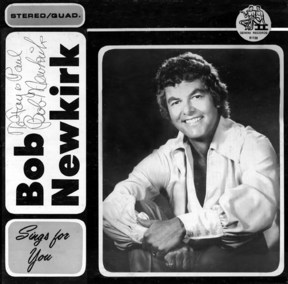
I guess I should begin with the album cover:

Collectors take note, that is his real signature...
This album was released by the apparently homosocially adventurous (check out the logo) Gemini records in 1973. It is numbered 91728, and were I to find out that there were 91,727 more records like this in the world, well then we would have solved at least one of the world's more nagging problems.
A live album, this record (a quadrophonic pressing, no less) seems to be a 'best of' his run at a very typical dinner lounge filled with very typical mid-century Floridians, the scene awash in clanging flatware and table knockers. You do know table knockers, don't you?

While there is much in the way of wonderfulness in this recording, it's his
My Fair Lady medley that is the real gem (though his version of "If I Were a Rich Man" has a "HUB-BUB-A-BOYA" solo that makes me weep, the Brigadoon medley is pretty stellar, and the two (yes, two) versions of "Old Man River" are enough to give anyone significant pause...). It is a kinetic (almost aggressively so) amalgamation of the Lerner and Lowes musical that verily SHINES in the middle of the album. The real brilliance in a medley is its ability to disassemble an entire "work" into its constituent parts and then reassemble it, relying mostly on the use of musically solid (or at least novel) transitions. That is certainly what we're dealing with here. It is solid AND novel AND downright terrifyingly fun. Table knockers ahoy.
From the get-go this song charges full tilt with a timpanic-ish percussive flourish that sparks a vibrato-laden and huge Newkirk D that he carries for a full ten seconds before slowing and sidling up to the "towering feeling" that is "On the Street Where you Live." After our few seconds of "Street", we careen into the double time march fun of "Get Me to the Church on Time" where we meet Bob's congenial cockney accent as he sings out "bloomin' love." His accent is probably about as good as Ms. Hepburn, had we been able to hear her actually sing in the film...
The song then right-angles into "I could've danced all night" and really stretches out in it, giving us a chance to feel his Broadway chops. But then the momentum is checked and "I've grown accustomed to her face" slows down the march, though we hear a touch of the dinner performer peek out here when he says "her UPS, her downs..." with that weird wink-wink conversational tone expected in parodies of the lounge singer genre. Then come the jaunty woodblocks and the LOVERLY that just get us geared up for what I think of as THE LINE.
Via a nice little "Show Me" segue, Mr. Newkirk jumps into "Rain in Spain" with an enthusiasm that seems to suggest that he would rather have just sung this song in its entirety.... But. . . This is the moment.
With a long rolled R and the faint sound of a fork hitting a plate, Bob gives us:
"The rrrrrrrrrrain in spain falls mainly on the plain (but NEVER on the golf course, folks)! The rain in spain falls mainly (haha) on the plainnnnnnn."
I'm still amazed that he actually says that. "NEVER on the golf course folks."
Then the song goes back into the tail end of "On the Street Where you Live" which wraps the whole thing up in pretty predictable fashion.
But that golf course line paired with the not-so-vaguely cynical laugh is what still sticks with me. I guess when I first heard the song I really believed he believed it. He just sounds like he's working a crowd, well within the contextual boundaries of mid-century lounge singer. It was (and is) funny. And, when listened to in the midst of the entire record, so much the better. it makes sense that he would talk like that. However, over time, I've grown less sure of that reading and, as such, I keep wanting to know more about this whole thing...
So, some years later--this is through the early days of searchable music content on the internet--I would regularly hunt for Bob (using webcrawler, altavista, all of them), wondering if he still had a career and so on, but it wasn't until just a few years ago that I found out that he had managed to make his way back into the entertainment world, though in a rather odd way... It seems Bob married a showgirl named Diana in 1965 and began to tour across the US (stopping in Miami for a spell, where this record seems to have been made). Along the way they had a few kids and the showgirl found Jesus and divorce proceedings and subsequent remarriages rendered them all a well-and-truly-broken American family.
Now, years later, Bob no longer sings for a living. It seems he "[carries] out health checks on customers at supermarkets" (this is a direct quote from an article I found, as I'm not quite sure what it means to do this, but it can't help but sound a bit sad) while one of his daughters from this first marriage is a big pop star in Europe and Asia... She goes by the name Anastasia, but she is Anastasia Newkirk, daughter of our dear Bob. It seems they were estranged all these years but, in the process of writing one of those probing bio-interest-celebrity pieces for the Sunday Times, Paul Scott reunited the two (or at least let poor Bob know who and where his daughter was).
By the way, Anastacia was a finalist on the MTV show "The Cut" and since then she's been on VH1's "Diva's Life," sold millions of records for Epic Records, and even has a "Best Of..." compilation.

I guess the most heart-rending moment in the whole story is where Bob talks about listening to her on the radio (he calls her "Stacy") without realizing it was his daughter... and then goes on about how his children have ignored him: "I haven't moved in 12 years. I am in the same place and they are certainly aware of where I'm living. My number is in the phone book, so Stacey is being not too truthful when she says she doesn't know where I am." But it all ends on a positive note: "I am so proud of her, but the fame doesn't matter, I would just like to meet her and see if we can start again. I don't want her to leave it until it is too late."
Now as I go back and listen to those little adlib moments in the medley, they sound dark to me, like he's playing to the cliche in this pre-ironic, though self-aware (and a wee bit angry). Of course he was in the heat of the moment, but there is an odd bit of bitter prophesy in this song. Just as when he asks people to "grab those table knockers and swing out, this is
fun time" at the start of "King of the Road"... one feels a touch of contempt for this Miami audience that keeps dropping forks and coughing during his well-wrought, perfectly timed, one-from-the-heart set(s).
Scott notes in his article that when the Newkirks were in Florida for these shows, he would often get the kids up on stage to sing to keep them from "getting bored"... I can't help but think this is a rather callous way to envision the whole thing, obviously colored by years of distance and bitterness on Bob's part and a wee bit of condescension on Scott's. However, maybe this is as close as Bob was to get to real stardom: singing together with a girl that is to become the "pop star Anastacia" on a Florida dinner stage, table knockers in full knock and family in full swing. A much finer picture of the musical family than the singer-cum-customer-analyst estranged from his diva daughter (just
look at that picture of her).
I guess now I just see Bob Newkirk as emblematic of so many failures that nostalgia and kitch culture gloss and haze into quaintness. Maybe we should keep music off the golf course after all.
If you'd like to read more about the two: the article is
here.


 I guess I really should talk a bit about a song that I swear by. . . in that most literal of terms. When I need to make a "s'wounds" sort of swear, I reach for Ali Thomson's "Take A Little Rhythm." Nothing says soft anger like a man muttering "take a little of that sweet sweet music" under his breath in a public space.